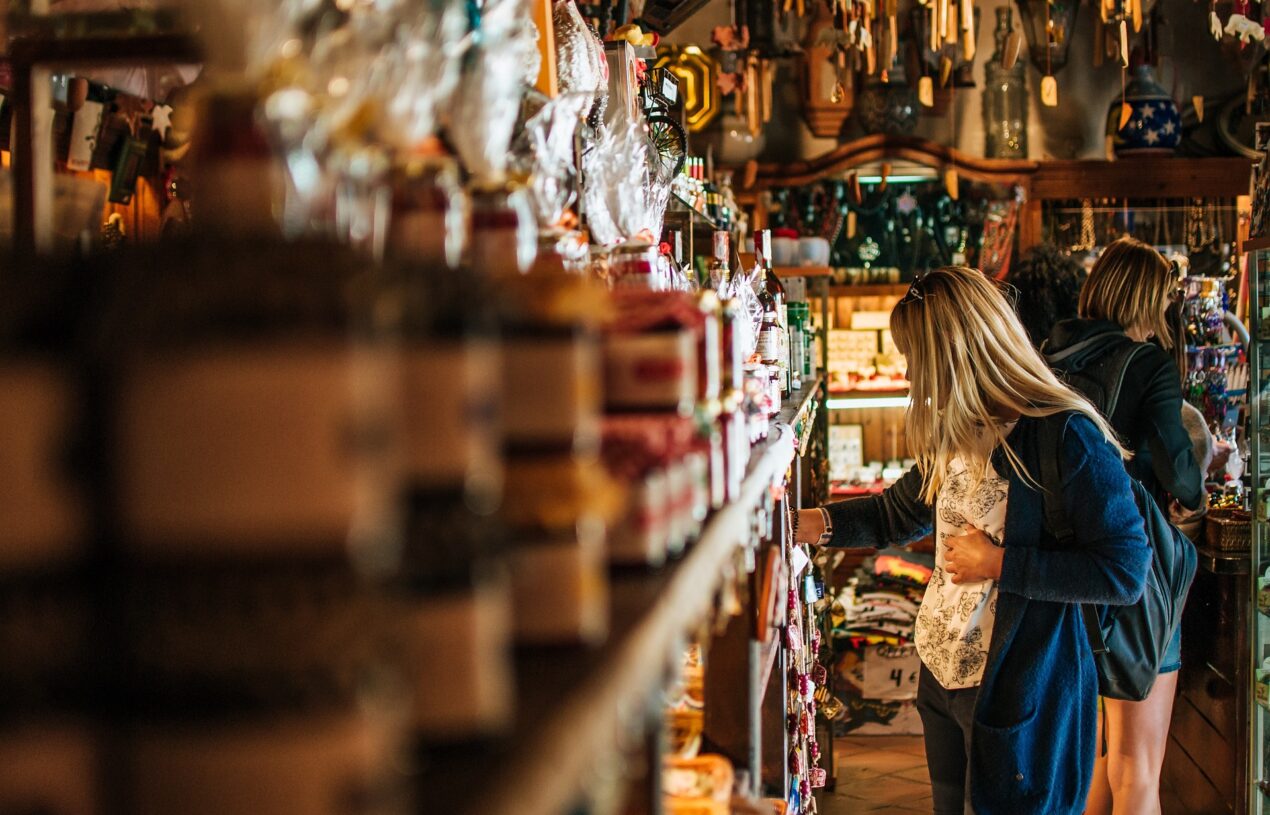
Along with the new lifestyle, the modern consumer easily accommodated to the advantages of a free market. He embraced a wide variety of products and services at good quality and well-balanced prices that could not be enjoyed 20-30 years ago. Without thinking too much about who is behind these advantages, the consumer enjoys a new social, political and commercial life without realizing that his daily life passed through a fabulous change.
Many of us will easily remember when it was time to buy for us school clothes. We always complained about a small variety of products. Everyone had the same 2-3 models of sports suits, dresses, jeans, or shoes. Only those who could find a very good tailor and a nice piece of cloth had the luxury of wearing something special and tailored to their sizes.
Also, there were the ones with relatives that went to work or live in Western Europe or in America – they had clothes, games, and products that most of us could not even imagine.
I did not have any relatives living or working abroad until the 2000s. So, my only memories of clothes and the market are that all the girls at my school between 7 and 10 years old had the same clothes, including me. Different from this I also remember when my grandmother tried to get fabric for a dress (a cousin was getting married). She often told me how happy she was when the woman who sold cloth brought some new goods. And everything does not end here. After buying the cloth, she waited for days until her sister came to visit her. Her sister could sew. So, once she arrived my grandmother asked her to take the measurements and make her a nice dress, which she had to bring the next time she came to visit (this could be in 1 year). While waiting, my grandmother had to be careful not to gain or lose too much weight, otherwise, the whole work was in vain).

Why didn’t we have variety?
The reason why there was very little variety in the market is because the nation-states controlled the market. Given that this happened, the state allowed itself to make a small variety available to people because it knew that people would buy things anyway because they needed them.
Then there was the ideology of such a nature that it encouraged social uniformity. Whether it was about the style of clothing or the place of work, the state encouraged people to be all the same – without extremes. This is how we had reached the point where uniformity was desired everywhere, whether it was about performance at the job, merits, personal development, etc. – you were encouraged rather not to exceed the average, but not to be below it either.
Later, when the statocentric regimes could no longer be maintained, they were replaced with new regimes. In the case of Europe, this new lifestyle brought a new model of social organization, a model that had been practically applied by the USA, and recommended to the European states.
This new lifestyle and the new political regime that began to sprout in Europe in the 1950s are responsible for changing the ideas, principles, and social, political, and economic values that influenced our consumer rights.

How does the new regime influence us?
Unlike the old regime where we were all encouraged to be the same, the new regime separates the political from the economic and defines the market as an independent actor capable of self-regulation. Meaning that the market becomes free to develop naturally without the political intervention of the state.
Under these conditions, the common market of the EU and the four freedoms opened many doors to consumers, as well as producers and traders, etc.
However, because the common market opened wide the doors to economic profit, it was not left in the hands of producers, traders, and economic agents. They always seek to increase profit, and for this reason, their first natural step would have been to expand on the market with the intention of establishing a dominant position, which would later give them the power to establish the market rules.
For this reason, the EU laid down two policies aimed at protecting consumers from any deceptive actions of market actors, namely, the competition policy and the consumer protection policy.

Who is responsible for the variety of market products?
If the consumer protection policy is oriented towards punishing the actions of economic actors, then the competition policy is intended to prevent actions that could cause any harm to the consumer and destabilize the market. Starting from here, the EU competition policy is responsible for the variety of products, the different quality and prices, the quality standards of the products throughout the Union, the balance of the products on the market, etc.
Ever since the formation of the European Single Market, the EU member states expressed their concern about the large producers and traders that would swallow up local producers from all over Europe. For this reason, the EU laid the foundations of the competition policy and constantly exerts pressure on the nation-states for its right application.
This policy together with the Common Agricultural Policy (CAP), established in 1962, establish quality standards, especially among food products. The intention of the competition policy is to put pressure on the market actors to comply with a set of rules that intend to protect the consumer by managing the actions of the market actors. For this reason, as you can see in my book “The new social reality of the Europeans: a constructivist view over Europeanization”, I named and classified the consumers’ rights as the fourth generation of rights in addition to political and civil, economic, cultural and social, and collective or solidarity rights.

Conclusions
The rights we enjoy nowadays as consumers should be fully appreciated. We must realize the huge change that took place and its impact on our everyday life. We have a wide variety of products and services and a policy that puts continuous pressure on companies in order to encourage them to innovate, to encourage research and technologization for the development of new production methods, new ideas, and work techniques. This encourages continuous development so that the consumer can benefit from the best product at the best price at any time.
All this time we have institutions such as the Romanian Competition Council and the National Authority for Consumer Protection, in the Romanian case, that follow the application of policies and manage the market in our favor.
These authorities interact with the public and are open to observations regarding the violation of competition rules and petitions regarding the violation of consumer rights. So do not hesitate to contact these institutions if you have been the victim of a case of unfair competition or a case of violation of consumer rights.