

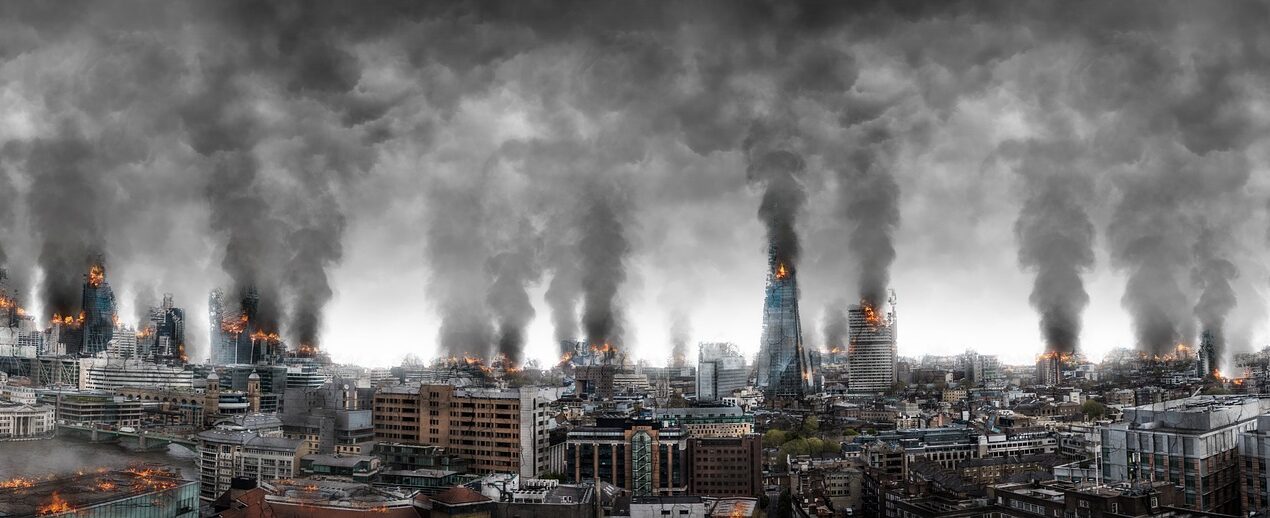
Our history is full of conflicts. And today, even if we are talking about peace our life is full of conflicts. There are many types of conflict unleashed because of different fears we have. These fears often make us act without thinking about the effects or possible chains of consequences.
So, in this article we will do an exercise based on an analysis of our World and our daily lives to observe and understand how the conflict has become normality together with fear, insecurity, alarm and other feelings.
Let’s start by looking deeper at the word conflict. What do we mean by conflict?
Most of us will probably think of armed conflict, battles and wars because this word has been associated primarily with an image of war since ancient times. So, to understand conflicts of this kind we must find out what were the main reasons that turned the wars into normality.
One of the most recent and well-known conflicts is in Syria, which came to our attention only when the immigrant crisis began, even though a civil war has been taking place there since 2011. However, neighboring states such as Iran, Iraq, Afghanistan, UK, France, Turkey, Yemen, Saudi Arabia, Israel and the superpowers, Russia and the USA, have been paying attention to events there from the very beginning and they were fully involved. Now, the experts say that the conflict has escalated from the following issues: high unemployment rate, corruption and lack of political freedom. If we look at what underlies these problems we will see that it is the fear of not having a job and money to survive; the fear of being unable to solve problems due to corruption and the fear of being stuck in a society where the political system tells everybody how to live every day without taking into account the social needs. On the other hand, the political leadership’s response to social discontent can be explained by the fear of losing power.
The subsequent involvement of the states was justified by the fear of an escalating conflict which can break the peace in the whole world. Some researchers claim that the involvement of states was not only about the fear of an escalating conflict but also about the fear of losing access to the country’s resources – resources on which their economic and military status depends.
Following this analysis we see that a vicious chain of fears provoked a war that caused 367.965 deaths and 192.035 missing people.
Another conflict is in Iraq. In 2003, the United States and its allies invaded Iraq with the intention of finding weapons of mass destruction and fighting Saddam Hussein’s terrorist regime as an answer to the 9/11 terrorist attacks. Following the searches, these states did not find any weapons of mass destruction but remained to fight against the regime. This thing shows that the conflict was initiated out of fear of terrorism and unforeseen attacks. However, the fact that the US has involved again in the conflict in 2014, after withdrawing its troops in 2011, shows that the US is not only interested in fighting a regime whose leader was executed in 2006. The political analysts claim that the US and its allies would have sought not only the fall of a military regime, but also the establishment of relations to ensure their access to Iraq’s oil resources.
So, this war, like the one in Syria, started from fears and greed of people and governments.
Now, let’s look back 82 years ago, the World War II. What fears can we talk about here?
World War II started both from fears and antecedents after the First World War and from desires of domination. Fear was the factor that has led Germany to support an extremist party. After years of paying war debts, famine and economic depression, Hitler had come as a solution to the German people’s fear of starvation and enslavement to the Entente. Giving up the payment of war reparations, and a few years have helped the new leader to put Germany on its feet, and prepare for a new war to subjugate the nations that dominated Germany between the first and the second World Wars. On the other side, the neighbouring states responded to the war challenge because of the fear of being subjugated to the Germans that had already begun the purification of their nation by killing or sending to concentration camps people who were not of ‘pure’ German blood.
So World War II was also based on a group of fears rooted in antecedents.
The First World War had its other fears behind, like the one of being dominated, distrust and arms race. Fear increased due to mistrust, which triggered the pre-war naval arms race that convinced countries of the certainty of a war.
By looking at all these wars, we can easily notice that the reasons behind them were nothing more than fears and instincts we couldn’t control. Obssessed of the idea of ownership and the desire to have more by thinking about tomorrow, we fell into the trap of fear and allowed the war to take place and destroy us all.
In order to understand what made us turn war into normality, we will have to go much further and look into other forms of conflict, namely conflicts between ethnic and religious groups, between families, family members and the conflict within us.
Let us now see what fears underlie religious and ethnic conflicts.
Crusades and terrorist attacks in the name of God did not and do not have religious logic behind them. The Christian, Islamist, Buddhist or any other religion support the idea of helping your neighbor, not hurting each other, and so on. So it was not religion that was and is the basis of our acts of violence, but certain fears. For example, during the Crusades very few people had access to education, so the only way to access religious texts was through religious places. As they were not politically independent, some priests of their own accord, others under political pressure, interpreted religious texts giving reasons for fear to the population which encouraged the religious wars. Although there is not much talk about Crusades, to get an idea, only one massacre, the one of Ayyadieh, resulted with the execution of 2000 Muslim prisoners.
In the case of Islam, we talk about another fear, the one of living in war for the rest of their lives, or having their resources stolen without the opportunity to independently manage internal conflicts. In addition to fears, there is also resentment against countries that sell weapons to locals and make war possible, which get involved in the war by resolving matters to their advantage instead of that of the citizens of Islamic countries.
In both cases, the Crusades and the islamic violences, we can speak about the interpretation of religious texts in the advantage of the political ideas and of educational institutions being managed by religious and political powers. Because educational institutions have the mission to form the future minds of society, politics and religion must not be involved ast the past has shown that they can lead to the awakening of countless fears even when it is not the case.
Then, conflicts between families often start because of competition: who has a bigger house, more money, whose children are more successful, etc. So we witness the fear of being the weakest in a competition. We can say that it is about the instinct to dominate, which engages us in competition because the one who has more is the one who will establish the rules. This way we end up competing with each other within the same family because who has gone further or has more will have the right to advise and establish the future of the family.
All these types of conflicts lead us to the so-called internal conflict, the conflict in which our desire to do something faces the family and social pressures to conform to the social system and to follow this permanent competition in which we accept what they say it’s good, what they say we should like, what they believe should make us happy. So we remain divided on the inside and outside, a battle between personal desire and what they say is good or bad.
Therefore, the source of conflict is in fears, natural instincts, competition to impose rules and the desire for integration. At this point we should ask ourselves if it is possible to live in the same world where the one who has reached above does not enslave the one below, where we can tolerate our personal beliefs and desires, where our life should be as we want not as society wants, where we can be reconciled with ourselves and happy every day?
To achieve this goal we need tolerance, love, self-knowledge and peace.
Sources:
- BBC. (2019, 02 01). Why is there a war in Syria? Retrieved 01 20, 2021, from BBC: bbc.com/news/world-middle-east-35806229
- Biography. (2017, 04 27). Saddam Hussein Biography. Retrieved 01 20, 2021, from Biography: biography.com/dictator/saddam-hussein
- Blakemore E. (2019). Germany’s World War I Debt Was So Crushing It Took 92 Years to Pay Off. History, history.com/news/germany-world-war-i-debt-treaty-versailles.
- Danju I., Maasoglu Y. and Maasoglu N. (2013). The Reasons Behind U.S. Invasion Of Iraq . Procedia- Social and Behavioral Studies, vol.81, 682- 690.
- Mufti I. (2019). Ten commandments in the Quran: a quick introduction. The Religion of Islam, islamreligion.com/articles/5114/viewall/ten-commandments-in-quran/.
- The Wiener Hlocaust Library. (2021, 01 20). The early years of the Nazi Party. Retrieved 01 20, 2021, from The Wiener Hlocaust Library: theholocaustexplained.org/the-nazi-rise-to-power/the-early-years-of-the-nazi-party/what-were-hitlers-ideas/
- Wilde R. (2020). The Major Alliances of World War I. Thought Co, thoughtco.com/world-war-one-the-major-alliances-1222059.