One of the topics discussed on the first day of the Bucharest Security Conference 2022 organized by the National School of Political and Administrative Studies and the NATO Research Center was security in the Republic of Moldova in the context of the War in Ukraine. The officials and academic members wonder what the next moves of the government led by Maia Sandu are. The situation in the area was described in a sincere and critical note by the former Ambassador of the Republic of Moldova to NATO.

Mihai Gribincea at BSC 2022: Some things happening today in the Republic of Moldova may turn from risks into vulnerabilities. The first risk is about the foreign policy which is the reflection of the domestic policy. In the case of the Republic of Moldova, both are weak because Moldova has some structural vulnerabilities.
Then, society is in great division. We often talk about the Transnistrian conflict and the territorial division, but we also have an ethnic and linguistic division. For almost 30 years, the government failed to integrate ethnic groups into society.
In Moldova we can also talk about a church division: on one side we have the metropolis of Moldova and on the other the metropolis of Basarabia. One might think that this does not matter, but remember that when the election period comes, the Metropolis of Moldova, which is submissive to the Russian regime, we cannot neglect this subject anymore, because the church shapes the public opinion and influences the votes.
From an identity point of view, part of the Moldavian population considers to be Romanian, and the other part considers itself Moldovan. Each of them votes in a distinct way.
The ambassador considers that building a state by denying the Romanian ethnicity is a mistake that was perpetuated by all governments since 1990. This is a problem because in Moldova, unlike other states, minority groups are recognized more than the entity of the majority.

This sculpture is called “Hora haiducilor” (2010-2011) that can be found near the village of Bravicea.
Another vulnerability is the problem of Gagauzia. Gagauzia can broadly be compared to Transnistria, but in Gagauzia we do not have a Russian military presence. Again, I identify a mistake of all the governments that failed, namely that they did not try to build a policy of bringing Gagauzia closer to Moldova. On the contrary, Chisinau has delegated many problems to other states or organizations. An example is the OSCE initiative to teach the Romanian language in Gagauzia. This initiative was a very good one, but what do you guess was the Chisinau Government’s answer? Instead of supporting this, they informed the OSCE representatives that they cannot help in any way in because the government has no resources.
At the moment, Gagauzia receives financial aid from various countries such as Turkey, Russia, Georgia, etc. This is how it came to be that in this area of Moldova you will find better hospitals and schools than in the rest of the country. But, starting from these aids, Gagauzia is now waiting to be liberated by Russia.

Last but not least, there are discussions about the neutrality principle of Moldova. Over time, this has become more of a security risk than a guarantor of it. Moldova declared itself neutral in 1994. The Constitution says in art. 11 that Moldova does not accept the presence of military troops on its territory. Another article completes this principle by invoking that the neutrality of Moldova can be changed only on the basis of a referendum. From this point of view, changing this principle will be very difficult, especially when society does not trust institutions.
In the Republic of Moldova, the pro-Russian forces, including former presidents, used this principle to avoid financing the army and security development. And the new government invoked this principle throughout the war in Ukraine, and only at the beginning of June, after President Macron’s visit to Eastern Europe, the Moldavian President Maia Sandu started to talk about security in the Republic of Moldova.
It must be said that Moldova had the opportunity to reform the army. A few years ago, Great Britain proposed to Moldova to bring the army to European standards. The problem was, however, that the government announced that there are internal discussions and debates regarding this proposal.
Finally, what I want to say is that Moldova must make it clear to Russia and the Transnistrian separatists that a potential invasion of the Republic of Moldova will come at a cost. At the moment we cannot say this because we do not have military capacity. The government should carry out a campaign regarding the trap of neutrality. The vulnerabilities I mentioned, in the beginning, can be overcome with different programs.
Although the former Ambassador sees a solution in overturning the principle of neutrality, a deeper analysis was presented by Vladimir Socor, a political analyst of the Jamestown Foundation and Eurasia Daily Monitor, specializing in Eastern Europe.
Vladimir Socor at BSC 2022: The Republic of Moldova faces a set of vulnerabilities triggered by Russia’s influences and a set of internal vulnerabilities.
- In terms of internal problems, the biggest problem is the underdeveloped level of national consciousness. This is where many other problems arise that make Moldova vulnerable to Russia. What differentiates Moldova from Ukraine and Georgia, is that these states have a military culture within society. Starting from this aspect, both Ukraine and Georgia see Russia as an opponent, while Moldova sees it as superior. Those from the Republic of Moldova have to take into account these internal realities.
- The majority of people in Moldova show a lack of interest in Transnistria. For this reason, any political decision to be taken by the political class about Transnistria will not be reflected in their ranking in the elections. Whereas in any other country, if this happened, things would proceed in a completely different way.
- In Georgia and Ukraine, 70% of the society wants NATO membership while in Moldova only 20% of the population wants this. Under these conditions, it will be very difficult for Maia Sandu and PAS to obtain a second mandate. Maia Sandu and PAS need at least 2 mandates to complete the necessary Europeanization reforms. Today, all public opinion polls show that Maia Sandu and PAS risk losing the next elections in front of the Socialist Party, and SOR party as shown in the public opinion polls. Of course, the polls were conducted only on the citizens of the Republic of Moldova that live in Moldova and did not consider those from the diaspora, but it should be mentioned that in the previous mandate Maia Sandu won the local elections because she won slightly above the average in the country as well. So the situation is complicated.
At the conference, was also asked the question of whether is the Republic of Moldova a target of the Kremlin’s war.
My answer is no. Moldova is not an immediate target or a strategic target in itself, but it can be absorbed by the conflict. Why am I saying this? Because Moldova does not have a geopolitical value for Russia or NATO, because nothing passes through Moldova in terms of transport routes. Also, Moldova is not a big commercial, financial or economic center. It is a relatively poor country, with no resources and no access to the sea. Russia never wanted to turn Moldova into a Soviet zone, but rather wants to ensure that Moldova is a gray area without functional governments. Russia wants to be a shareholder in the Moldovan political system through pro-Russian political parties. This explains why the Russians gave help to Igor Dodon. Russia could of course have given more help considering its abilities, but this of course is another subject to discuss.
Another important thing is that Russia realized that NATO is not willing to accept Moldova as a member country even in the near future because Moldova is not a geographical area of interest.
In another order of ideas, Maia Sandu avoided any criticism of Russia both before and after the elections. She focused on making internal reforms and enforcing democracy. After winning her mandate, she assured Kozak that Moldova has no negative intentions toward Russia. Maia Sandu did this because she cares about the electorate and about winning at least the 2nd term in order to complete the Europeanization reforms and become a good party in the voters’ eyes. The president of Moldova only recently used a harsher statement, compared to her usual speech, in which she said that “the bombings of the Russians in Kharkiv and the aggressions there were barbaric”.
Now on the subject of neutrality. It was declared by Moldova in 1994, out of the great hope that Russia would withdraw its troops from its territory, even if this did not happen because look at Transnistria.
It should be mentioned, however, that Moldova is de facto demilitarized, it has no military capacity to defend against anyone. Its neutrality is bizarre and fictitious, as it is not a security solution. The neutrality until now is based on hiding behind Ukraine. Moldova has no direct borders with Russia, thus it has always hidden behind Ukraine although in the past it had conflicts with Ukraine. In a way, we can say that Moldova took advantage of its geographical position, but the big question is why Moldova does not take advantage of this unique situation to integrate into the EU. Neutrality has become a kind of component of the national identity of Moldavians. Just as it was in the case of the Finland until recently. A large number of the Moldovan population approves neutrality as a form of protection not necessarily against Russia but against any aggression. However, Russia discredited any form of neutrality in the EU a long time ago.
Let’s look a little further: Georgia and Ukraine have the goal of joining NATO in their constitutions. But the Republic of Moldova does not have this goal. Moldavian society is afraid of joining NATO and prefers neutrality. For the same reason, the government does the same. Moldova can change this, but if it did so now it would be wrong because the current government would not win another mandate.
Another topic is the internal politics of Moldova, which, under the conditions of this neutrality, could easily be overturned in favor of the Russian forces if the Russian army reached Odessa.
Again, the military and security consequences if the Russian army were to reach Transnistria – I don’t think that Russia would introduce troops on the right bank of the Dniester. I think they would increase the military contingent in Transnistria and put the airport in Tiraspol into operation. But as they separated from Odessa, at least for the moment, this possibility disappeared. Yet, this war is far from over. We still don’t know if the war in Ukraine will end with a frozen conflict.
Moldova is obligated, as are the states that support it, to build a security solution for the situation in which Russia reaches Odessa. This solution was never thought of, but it must be done at least now. Moldova is not capable of doing this on its own. On the other side, NATO will not do it either. NATO didn’t do this even for other partner countries in which it had great strategic importance.
The solution I propose is an ad-hoc meeting. Let’s take for example Ukraine: NATO as a whole has never approved military aid to Ukraine. NATO has provided assistance at a non-lethal level and at the border of technologies with civilian and military applications. Military aid was granted by the USA, Great Britain, and France, who also gave combat instructions. This informal group coordinated and functioned without NATO approval. However, it must be said that NATO did not oppose this either.
The same model must be applied to the Moldavians: a group of states is needed to make a commitment to send lethal military aid for security. The Republic of Moldova cannot bear these while being a poor country with a population where the idea of funds for military resources is not accepted.
On a totally different subject- in Moldova, the PAS government is a socialist one, although it wants to be liberal even if it complies with the European Union and democratic standards. This happens because the PAS government is forced to adapt to society because the people there expect a socialist government; meaning that they are no ways to replace power without conformation to people’s expectations.
The subject of Transnistria: I don’t want to give the impression that Transnistria is an appendage problem- it is an intrinsic problem.
Another question is whether Russia can threaten Ukraine and Moldova from the territory of Transnistria. I would say that in the current situation it cannot. In Transnistria, the equipment was not renewed, and it cannot be renewed as long as Ukraine refuses the transit of weapons on its territory. There is no official potential there.
It is true that the military capacity in Moldova is so small that Transnistria represents a problem, but it is not a major problem because it does not function as a vacuum, and it cannot function as a vacuum. At most the Russians can send groups of saboteurs to Odessa.
In Transnistria, there is an interstate conflict between Moldova and Russia. Russia sincerely wants to reconvene a 5+2 format with the participation of Ukraine, so that Russia can rehabilitate itself internationally and diplomatically as a mediator in conflicts and appear in a civilized position. Russia is now isolated internationally and wants to restore this format to re-enter the diplomatic field. However, this format must be killed in an easy way and not be declared; by ceasing to mention it- it will disappear. Somehow, this is already happening in Chisinau and Bucharest in the last 2 years. The format does nothing but legitimizes notions instead of submerging them. In this vein, let’s follow how Russia pursued 2 special status projects in Europe: one in Ukraine and one in Transnistria, something special was also in Georgia. In Azerbaijan, the special status of the area that sparked regional conflict for years, Nagorno-Karabakh, was canceled. The same must happen in Moldova with Transnistria so that it does not remain the only Russian experiment with areas with special status.
Then, let’s turn toward organizations. The OSCE as a conflict management organization was completely destroyed by Russia’s veto. And at the moment, the OSCE is tolerated more by Moldova which plays Russia’s games. For this reason, again, the 5+2 format must be forgotten. The conflict in Transnistria will be solved only after Moldova establishes its own institutions and laws. In the absence of the rule of law in a practical way, it will be applied in a distorted way by different groups that will use the conflict to make transactions with different interests.
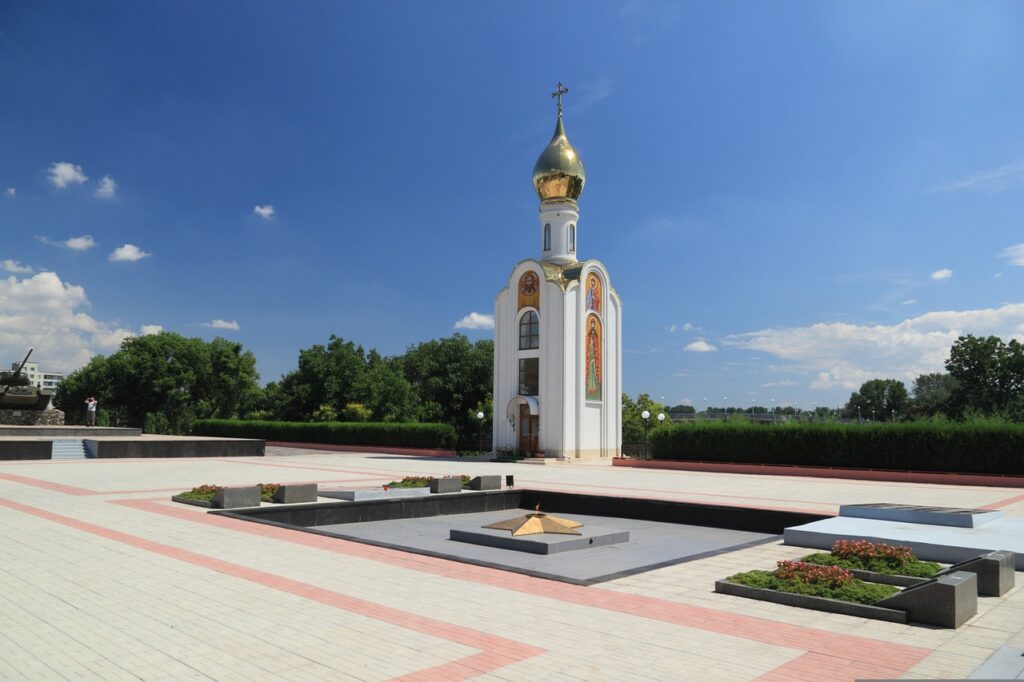
(Tiraspol Tower from Transnistria, Moldova)
In a somewhat similar line of thinking, we had the speech of the BSC guest from the Association of Experts for Security and Global Subjects. As a specialist in international relations and conflict resolution in Eastern and South-Eastern Europe, Angela Gramada presented a perspective that also takes social concerns into account. Her conclusions are drawn not only by considering the political issues but also by considering the social ones.

Angela Gramada at BSC 2022: The vulnerabilities of Moldova come from several directions and not only from Transnistria. There is a set of challenges that Moldova has to face together with security challenges. First of all, there are political vulnerabilities (there are challenges faced by the current government, as well as the past ones). We also have challenges of a social-economic nature, which are the result of the political decision.
We have to understand that in Moldova the problems did not appear now because of the war in Ukraine, they were there all the time. Yes, what is happening in Ukraine is new to some extent. But there were elements in the past. In 2008, we had the Russian Federation recognition of South Ossetia and Abkhazia, then we had Crimea. The current context has only changed the way the government thinks about the prospects of military security, but also about the socio-economic context.
The Moldovan public is alarmed when it comes to Transnistria. An example of this was the March panic at the explosions in Odessa. However, the main economic partner of Transnistria is the EU, and it is important to tell you this so that you understand why the leaders of Transnistria sometimes come forward to say one thing or another, and why in certain moments they support the political orientation from the east.
The 5+2 format is no longer valid primarily because Ukraine does not recognize Russia as a partner but as an aggressor. Based on these, Russia cannot participate as a mediator in a conflict it initiated. During Igor Dodon’s mandate, Moldova was used to present a model of conflict resolution, in which the leaders of the Transnistrian space were brought to the negotiation table. Also during that period, Russia came to Ukraine with the idea of federalization, in order to destroy the Ukrainian constitutional project. But of course, Ukraine did not accept this model.
For Moldova, it is also important, how the political environment communicates with the society. The government of Chisinau does not know how to communicate strategically. I talked in Chisinau at some point with a member of PAS, and I asked him: why are there no leaders of the party in public positions who can transmit reliable information? Something like this is needed. I mean, do not let me as a citizen to get lost in information. This is how we end up falling into very well-thought-out information traps. There are groups that influence public opinion, which even accuse the government of things it did not do. And the fight against this information is not done by silence.
Another problem is that the PAS party did not share the governing act with other political parties. The existing parties do not share the political orientation of PAS, yet these parties are strong and they will continue to exist. They are already building sabotage messages.
In another order of ideas, a topic that should not be avoided is European integration which is often associated with the unification with Romania. Because of this, the accession to the EU is seen badly by a large part of the population. Precisely for this reason, the unionists in Romania were silent during the electoral period of the PAS party, in order not to cause a wave of fear among those who do not support the unification with Romania. And rightfully so, this was a good strategy.
Now returning to communication, the authorities do not appear in front of the population long enough to explain that the price of gas was not established by Maia Sandu and that they are made on international markets; or to explain that the Republic will receive sufficient financial support from the EU to have a coherent social policy. But be careful, let’s not give society the impression that we want to be a country that lives based on subsidies. The Union can support us up to a point in this direction, but we must be a country of investments, not of social aid.
And finally, from the point of view of neutrality, Moldova must now discuss the solution of the Transnistrian conflict, and what is happening in Ukraine must be used in this sense.
Conclusions:
During the conference, I also saw positions that take into account the possibility of conflict escalation and the need to prepare for a nuclear war, for a frozen war, or for one carried out on multiple fronts. It must be said, however, that the facts show that this war is not a traditional one. It incorporates several dimensions besides the military, we have the economic and financial dimensions, we also have the cyber dimension, as well as the informational dimension. This war is different from those experienced by our grandparents.
One thing is certain, however, that as long as this conflict has a military dimension, we must be careful not to fall into the trap of fear and escalate the conflict. We do not want to turn the conflict in Ukraine into a World War. Therefore, political officials must be very careful in the way they approach this problem and not forget that the main solution is diplomacy, it is the only way to solve problems peacefully, and the lack of communication with the aggressor, as the European states proceed with isolating Russia, risks escalating things.